
Loading...
Serving Salina, KS and surrounding areas. (785) 201-1985
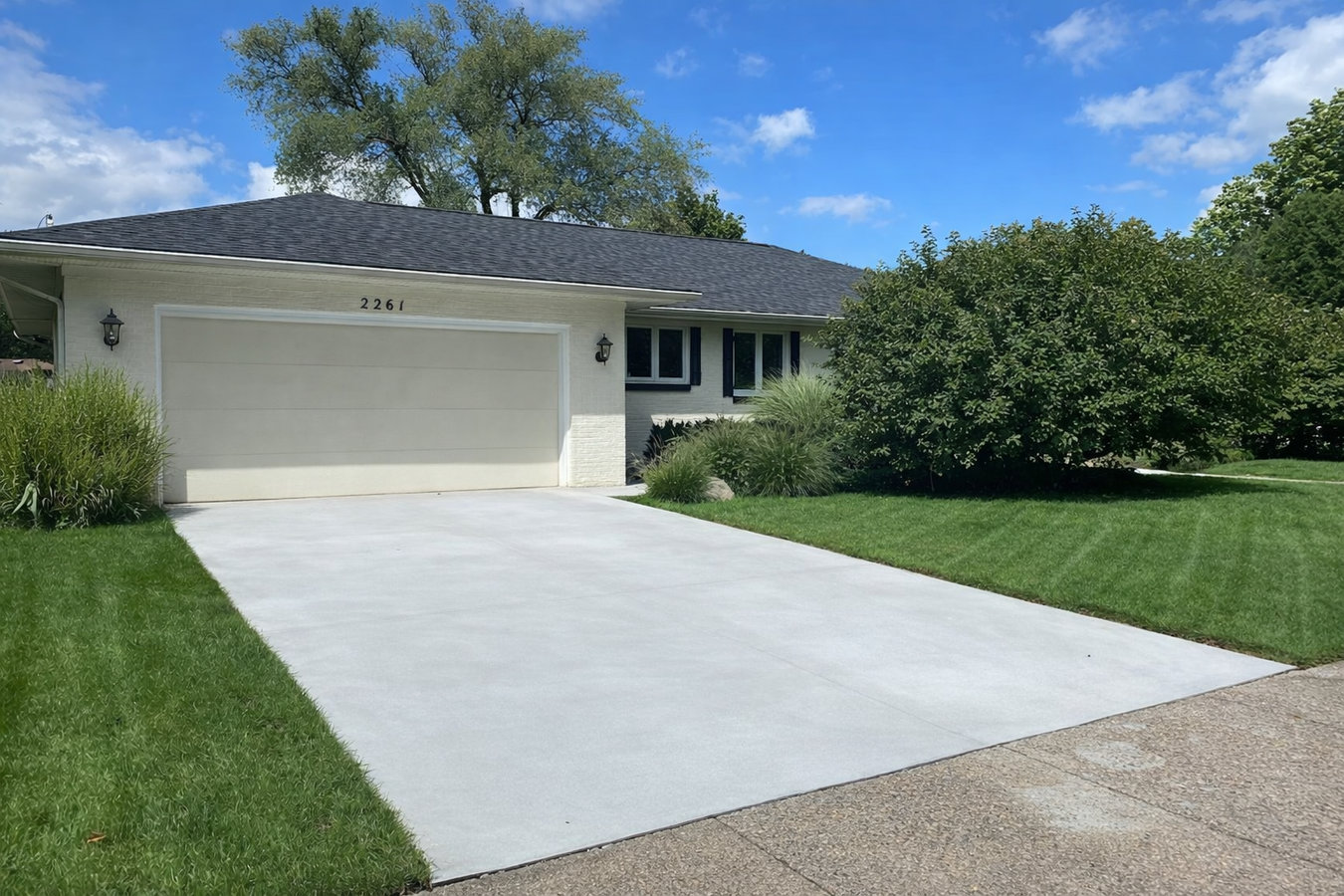
Salina Concrete Company serves Newton and Harvey County homeowners with concrete driveways, slab foundations, sidewalks, and patios. We know the clay soil conditions and cold winters here, and we give every customer a free written estimate within one business day of their call.
Many homes in Newton were built before 1960, and the original driveways from that era have been cracking and shifting for decades under the influence of Harvey County clay soil and hard Kansas winters. Our concrete driveway building work includes proper base preparation for clay soil so the new surface holds up through the freeze-thaw cycles that damaged the original.
Newton has a lot of detached garages and older outbuildings that need updated slab foundations - the original pours on many of these were too thin and lacked proper footing depth for Harvey County frost penetration. Getting the foundation depth and base right from the start prevents the heaving and cracking that brings homeowners back for expensive repairs every few years.
The older neighborhoods in Newton have sidewalk panels that have been lifting at the joints for years from freeze-thaw movement and root intrusion from mature trees. In Newton, sidewalk maintenance along street frontage is generally the property owner's responsibility, so a cracked panel creates both a safety problem and a potential liability for the homeowner who ignores it.
Many Newton homes from the 1940s through the 1970s have small rear yards that benefit from a solid concrete patio that connects the house to the garage and gives the yard usable outdoor space without the ongoing maintenance that wood decks require in this climate. A properly poured patio on compacted base handles the wet springs and dry summers of central Kansas without heaving or cracking.
Detached garages are common on Newton properties built in the railroad era and postwar decades, and many of those garage floors were poured thin without reinforcement. Decades of vehicle weight, moisture infiltration, and clay soil movement have left a lot of them cracked and uneven - a new pour with proper thickness and a sealed finish puts an end to the problem.
Newton homes built on clay soil sometimes settle unevenly as the soil shifts seasonally, leaving sections of a foundation lower than they were when the house was built. When a foundation settles rather than cracks structurally, raising it to level is faster and far less costly than replacing the foundation section - and it stops the damage to walls, floors, and door frames that uneven settlement causes.
Newton sits at the center of Harvey County on the same flat, clay-dominated prairie that runs across much of central Kansas. Clay soil expands when it absorbs moisture and contracts when it dries out, and that cycle repeats every spring and summer. Over time, that movement pushes sidewalks out of level, cracks driveways along their joints, and puts lateral pressure on basement and foundation walls. Newton winters add to the problem - January lows average around 20 degrees Fahrenheit, and the ground freezes hard enough that frost heave is a real and recurring cause of concrete damage every spring.
The housing stock in Newton makes this more of a concern than it might be elsewhere. A large share of Newton homes were built before 1960, including many that date back to the railroad era of the late 1800s and early 1900s. Concrete poured in that era was often thinner and less reinforced than current standards, and decades of freeze-thaw cycling have worked their way into surfaces that were already marginal. About 40 percent of Newton housing is renter-occupied, and rental properties in older neighborhoods sometimes have years of deferred maintenance. A contractor who understands how this specific combination of soil, climate, and housing age affects concrete work builds differently than one who does not.
Our crew works throughout Newton regularly, and we understand the local conditions that affect concrete work in Harvey County. Structural concrete projects in Newton - including new foundations, retaining walls, and driveway approaches connecting to city streets - require permits through the City of Newton. We manage the permit process for our customers so nothing gets missed before work begins.
Newton is laid out in a traditional grid pattern shaped by its railroad origins - older neighborhoods closer to downtown have mature trees whose roots have been lifting sidewalk panels for decades, while the postwar ranch-style neighborhoods on the south and east sides of town present different access and drainage conditions. Bethel College in North Newton anchors that side of the city, and the neighborhoods surrounding campus have some of the oldest and most character-rich homes in Harvey County. We have worked on properties all across Newton and know what to expect from both ends of the city.
We also serve Hutchinson to the west and McPherson to the north, so customers in Newton are never working with a crew that is unfamiliar with Harvey County and its neighbors.
Reach us by phone or through the contact form and describe your project. We respond to every Newton inquiry within one business day and schedule a site visit at a time that works for you.
We come to your Newton property, assess the soil conditions, measure the work area, and give you a written estimate before any work is agreed to. There is no cost for the estimate and no pressure to commit on the spot.
Once you approve the estimate, we handle permitting if required, prepare the base to the depth Harvey County clay soil demands, and complete the pour on the scheduled day. Most residential pours are finished in a single day of work.
After the pour we walk through the finished work with you, confirm the cure timeline - at least 24 to 48 hours before foot traffic, five to seven days before vehicles - and answer any questions before we consider the job complete.
We serve Newton and Harvey County with free written estimates. Call or submit the form and we will be in touch within one business day.
(785) 201-1985Newton is the county seat of Harvey County and sits about 25 miles north of Wichita on US-50 and I-135. The city traces its roots to 1872, when it became a major stop on the Atchison, Topeka and Santa Fe Railway and briefly served as the northern terminus of the Chisholm Trail. That railroad history shaped Newton's street grid and many of its oldest neighborhoods, and the city of Newton still has a significant stock of late 19th and early 20th century homes in its older residential streets. Today BNSF Railway, Hesston Corporation, and the local school and healthcare systems are among the major employers that keep Newton's economy stable.
The residential mix in Newton ranges from the oldest brick and wood-frame homes near downtown and the Bethel College campus in North Newton to postwar ranch-style homes built through the 1970s and a smaller number of newer subdivisions. Most housing is single-family and owner-occupied, though rental properties are spread throughout the older neighborhoods as well. Neighbors to the south include Hutchinson and the broader Arkansas River corridor, while Salina anchors the service area to the north along I-135.
Precision floor installations for residential and commercial spaces.
Learn MoreProperly engineered slab foundations for lasting structural support.
Learn MoreExpert foundation installations that give your build a solid start.
Learn MoreHarvey County clay soil and cold winters are hard on concrete. The sooner you call, the sooner we can stop the damage and give you a surface that holds up.