
Loading...
Serving Salina, KS and surrounding areas. (785) 201-1985
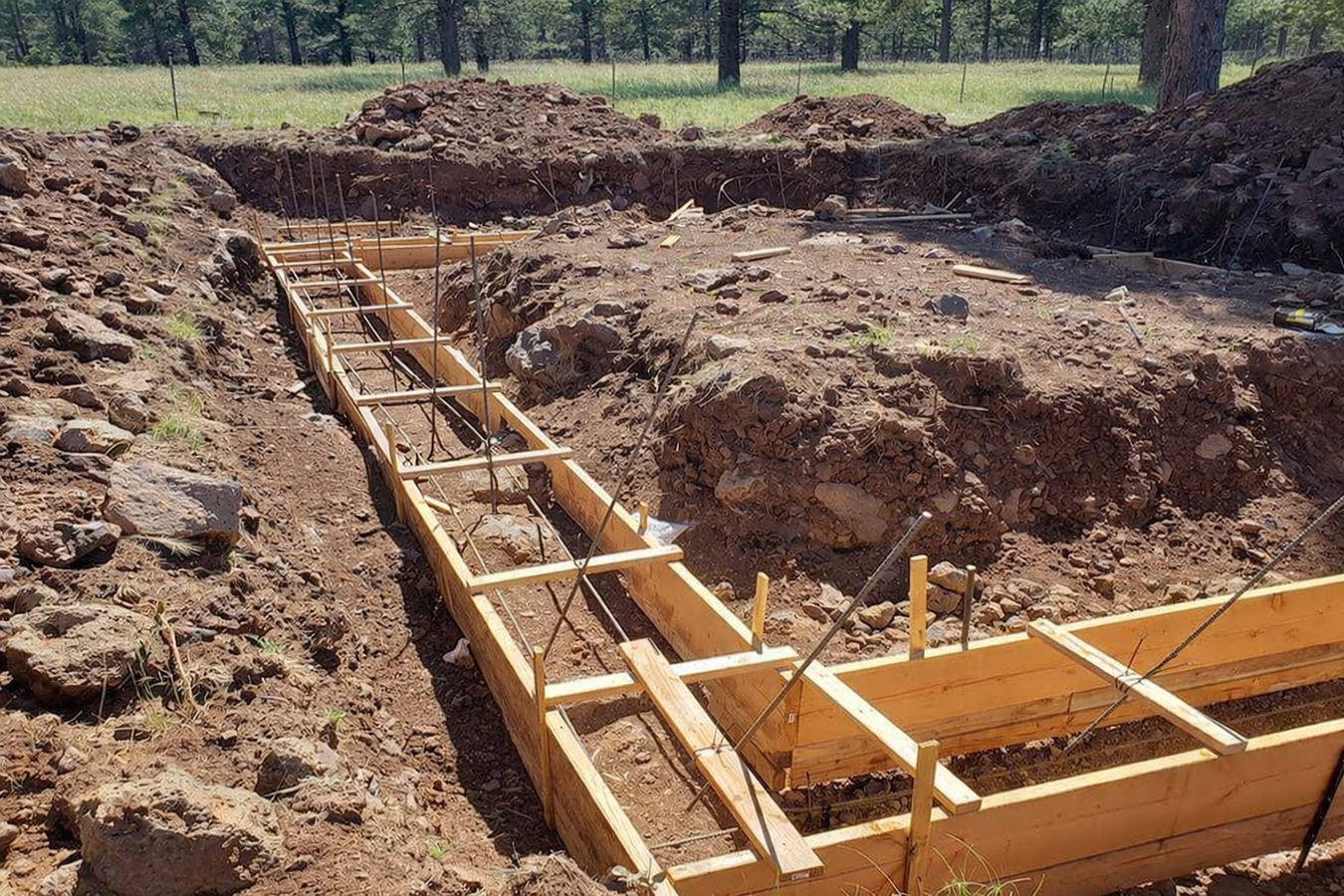
Adding on, building up, or seeing signs that something below ground has moved? We pour concrete footings in Salina to the correct frost depth, with the right reinforcement, so the structure above stays stable through Kansas winters.
Concrete footings in Salina are poured-concrete bases that sit below the frost line - typically 24 to 30 inches deep in central Kansas - and transfer the weight of a structure down into stable soil, keeping the building above from shifting when the ground freezes, thaws, or moves with moisture changes. Most residential footing projects take one to two days to excavate and pour, with a curing period of at least 24 to 48 hours before the next construction phase begins.
Footings are the first structural element in almost any building project - foundations, home additions, attached decks, load-bearing walls, retaining walls, and freestanding structures all start with a footing below ground. If you are planning a foundation installation or a full foundation raising project in Salina, the footings are where that work begins. Getting them right sets up every phase that follows.
The American Concrete Institute provides the structural design standards that govern how footings are sized and reinforced for different soil and load conditions. In Salina, where clay soils shift with seasonal moisture changes and frost depth puts real pressure on anything in the ground, following those standards is not optional - it is what keeps a footing performing for the life of the structure above it.
Cracks running at roughly 45 degrees from the corners of windows or doors are a classic sign that a footing or foundation section has moved. In Salina's clay soils, where the ground shifts with every wet and dry cycle, this kind of movement is not uncommon in older homes. Small cracks can be cosmetic, but diagonal cracks that are widening or recurring after patching point to something happening below ground.
If you notice that floors in a room feel like they tilt toward one corner, or that water rolls in a direction it should not, a footing or support column below may have settled. Salina's freeze-thaw winters can heave footings that were not poured deep enough, causing the structure above to shift unevenly over time.
A door that worked fine for years and now sticks or will not latch is often a sign the frame has racked slightly because the structure is out of square. This happens when a footing has moved enough to let one part of the building settle while another does not. In Salina's older housing stock - much of which was built before current frost-depth requirements - this is a common finding on homes built before 1970.
If you are planning an addition, a deck attached to the house, a new load-bearing wall, or any structural work in Salina, new footings are required before anything can be built on top. Footings are the first step in any structural project - getting them right sets up everything that follows.
We pour all types of concrete footings in Salina - continuous wall footings for new foundations and basement walls, isolated column footings for deck posts and structural columns, stepped footings for sloped sites, and reinforced footings for heavier loads. Every footing we pour is excavated to the depth required by Salina's frost line and local building code, with reinforcement steel placed before the pour to match the load the footing will carry. When the footing is part of a larger structural project, we coordinate with the rest of the work so the sequence and curing timeline do not create delays. Our foundation installation work builds directly on top of the footings we pour - and we handle both elements as one continuous scope when the project calls for it.
For projects where something below ground has already shifted, our foundation raising service addresses existing movement before new footings or repairs are placed. This matters on Salina properties where older homes - many built in the 1950s and 1960s - have footings that did not meet current frost-depth requirements or were poured without adequate reinforcement. Addressing the footing problem is the correct first step before any surface or structural repair above ground.
New foundations and basement walls where a continuous poured footing carries the load along the full length of the wall.
Decks, posts, structural columns, and outbuilding supports that carry concentrated point loads rather than distributed wall loads.
Sites with sloped terrain where the footing needs to step up or down with the grade rather than follow a flat horizontal line.
Additions, commercial structures, or any project where the load above exceeds what a standard unreinforced footing can carry safely.
Salina winters can freeze the ground to 24 to 30 inches in a hard year. A footing poured above that depth will heave when the ground beneath it freezes and expands - lifting the structure above it, then dropping it as the ground thaws. That cycle, repeated over several winters, cracks mortar, racks door frames, and eventually damages whatever is built on top. Most of Salina's housing stock was built between the 1940s and 1970s, and homes from that era sometimes have footings that predate current frost-depth standards. If your home is in that age range and you have noticed doors sticking, diagonal wall cracks, or uneven floors, the footings are worth investigating before symptoms get worse. In Manhattan and across north-central Kansas, the same frost-depth requirements and clay soil conditions apply - this is a regional issue, not unique to any one property.
Salina also sits on expansive clay soil that swells when wet and shrinks when dry. That movement creates lateral and upward pressure on footings even in summer, when prolonged dry spells cause the soil to pull away from foundation walls and footing sides. Footings in this environment need to be sized with that soil behavior in mind - not just designed for the weight above them, but for the soil pressure acting on them from below and the sides. Homeowners in McPherson and other communities in the region deal with identical soil conditions, and the same design approach applies to every project we take on outside Salina.
We respond within 1 business day. Tell us what you are building - a foundation, an addition, a deck, a retaining wall - and we will ask the right questions to put together an accurate estimate. We will also let you know upfront whether a permit will be required.
We visit the site to assess soil conditions, confirm the required footing depth for Salina's frost line, and handle the permit application if needed. The City of Salina typically requires a footing inspection before concrete is poured, so we schedule the pour around the inspection window.
We excavate to the required depth, set forms to the correct dimensions and alignment, and place reinforcement steel before the concrete arrives. Getting the footing dimensions and placement right at this stage is critical - everything built on top follows from these coordinates.
We pour the footing concrete, finish the top surface, and protect the pour during curing. For permitted projects, we coordinate the city inspection so you get sign-off before the next phase of your project begins. We give you a clear timeline for when the footings are ready to build on.
We respond within 1 business day. We will visit your site, confirm the frost-depth requirements, and give you a written quote before any work begins.
(785) 201-1985Central Kansas frost depth can reach 24 to 30 inches in a hard winter. We excavate every footing to the depth required by Salina's local code and confirmed conditions on your site. A footing that does not reach below the frost line will heave - we do not cut corners on depth.
We pull every required permit from City of Salina Building Services and schedule the footing inspection before concrete is poured. That inspection confirms depth and placement meet local code on record - which protects your project and gives you documentation when it matters.
Not every footing needs the same rebar layout. We size the reinforcement to match the load the footing will carry - whether that is a residential deck post or a full foundation wall. Proper reinforcement is what keeps a footing from cracking when Salina's clay soil shifts seasonally beneath it.
Much of Salina sits on expansive clay that moves with every wet and dry cycle. We account for that soil behavior when we spec footing depth and bearing area - so the footing performs in the actual ground conditions at your site, not just in ideal conditions.
Footings are invisible once a project is complete - but they are what every structure above ground depends on. We do this work to a standard that holds up through Salina winters and clay soil movement for the life of the building, and we back that up with permitted, inspected work on every applicable job. The National Association of Home Builders recognizes proper footing depth and reinforcement as foundational to residential structural performance - and in Salina's climate, that standard is not optional.
When an existing foundation has shifted or settled, foundation raising corrects the elevation before structural damage spreads further.
Learn MoreNew construction foundations in Salina are built from the footings up - we handle both the below-ground footings and the full foundation wall system.
Learn MoreEvery season that passes without addressing failing footings means more structural movement above ground - call today to schedule your site visit.